
Reviewed · OLD TOWN WALKING TOURS
History Walking Tour: Charm of Old Dubrovnik
Old Dubrovnik has a way of making you slow down, and this walk gives you a guided path through the city’s big moments in compact time. I like the small-group format and the way you spend real minutes at landmarks instead of just getting a quick glance. I also love having Dorotea at the front, turning gates, churches, and government buildings into stories you can actually place, but do note this is not a city-wall hike and it does not include museum entry.
The route moves in a smart order, starting at Ploce Gate and working through the harbor, major churches, and the centers of Dubrovnik’s Republic life. You’ll end near Brsalje Street with a viewpoint toward Lovrjenac Fort, which makes a nice wrap-up after all that dense old-town detail.
It runs about 1 hour 30 minutes to 2 hours in English with a mobile ticket, so it fits well even on a busy day. You won’t need to budget for museum tickets as part of the tour plan, though a couple of stops are tied to places where extra admission may be required if you want to go inside.
Key highlights you’ll feel on this walk
- Dorotea leads the story, with a real passion for Dubrovnik and Croatia that keeps the pace lively
- Small group up to 6 guests, so you can hear well and ask quick questions
- Start at Ploce Gate and end at Brsalje Street, a route that helps you get oriented fast
- Harbor and shipyard context, including why this stretch mattered in the Republic era
- Church stops that explain local religion, especially what makes St. Blaise so important
- View payoff toward Lovrjenac Fort, so your last minutes don’t feel rushed
Where this tour shines, and where it won’t
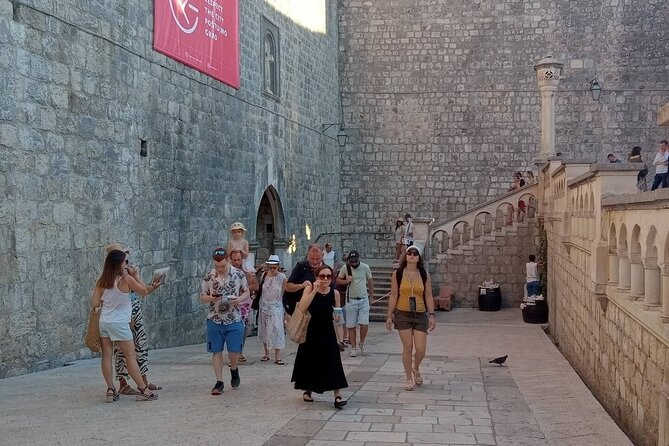
This is the kind of tour I recommend when you want context, not just coordinates. Dubrovnik’s Old Town is gorgeous, but it can also feel like a lot of stone and stairs if you do it alone. A guided walk like this helps you connect what you’re seeing to how the city functioned as the Dubrovnik Republic.
I also like that the pacing is built around quick “stop and listen” moments. Most stops are around 10 to 15 minutes, which is perfect in heat, wind, or when crowds make wandering slow. You get a steady flow of explanations that doesn’t turn into a lecture marathon.
The main drawback is simple: if you want to pay for city walls or go inside multiple museums, this tour is not the one that covers that. You’ll get stop-by-stop stories, but the tour plan intentionally skips entrance fees for museums and it does not include the ticket for walking the walls.
More Old Town walking tours:
- Dubrovnik: Old Town Walking Tour
★ 4.8 · 5,174 reviews - Dubrovnik Discovery Old Town Walking Tour
★ 5.0 · 4,458 reviews - Dubrovnik: Game of Thrones Walking Tour
★ 5.0 · 1,732 reviews
Meeting at Ul. Frana Supila 2 and ending near Brsalje Street
Your tour begins at Ul. Frana Supila 2, near the edge of the Old Town approach. That matters because it sets the tone right away. You are not starting deep inside the maze, you’re stepping into the story at the point where Dubrovnik first presents itself.
You finish at Dubravka 1836 Restaurant & Cafe, Brsalje ul. 1. This ending location is useful because it keeps you close to the lively Old Town lanes near Pile Square, so you can keep exploring afterward without backtracking.
The tour is offered in English, and you get a mobile ticket, which is handy if you plan to walk around with your phone already out for maps. It’s also a small-group experience with a maximum of 6 guests, which makes a difference in a place where sound can bounce around stone.
Stop 1: Entering Dubrovnik at Ploce Gate
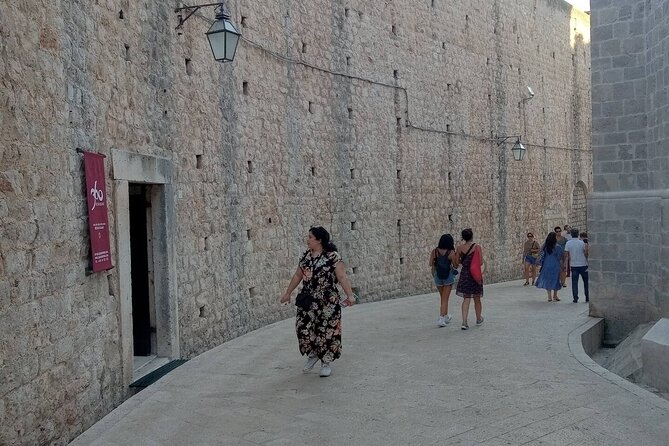
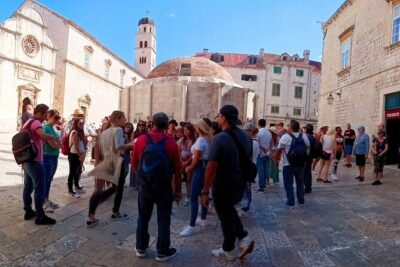
Ploče Gate is the eastern gate to the City, and it’s the perfect first stop. You enter the Old Town through this point and get a “big picture” start: how Dubrovnik formed its identity, and why these walls and gates were so important to the city’s survival and self-image.
This is where you start building mental landmarks. Once you hear the history connected to the gate, the rest of the walk makes more sense. You begin noticing entrances, alignments, and how different areas felt like separate pieces of one political machine.
Because the first stop is about setting context, I think it’s especially valuable for first-timers. Even if you have read about Dubrovnik before, a quick structured intro helps you see the town with less confusion and more confidence.
Stop 2: City Harbour, the shipyard heart of the Republic era
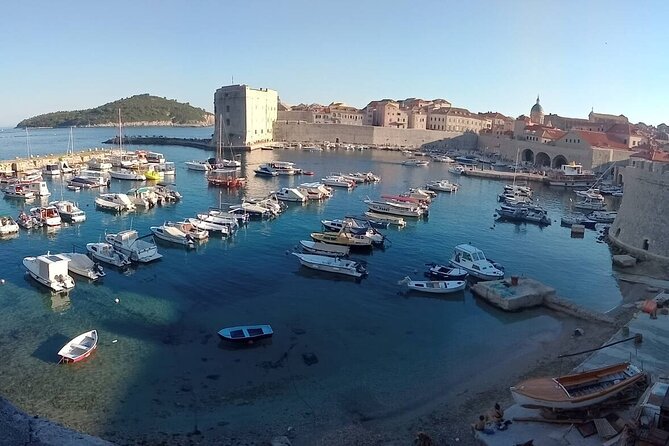
Next you head to City Harbour, one of the oldest and most important parts of the city from the era of the Republic. This is not treated as a generic “pretty harbor” stop. You’ll learn how the harbor functioned as a working area, including its role as an old shipyard.
A detail I really like here is the focus on repair and maintenance. The harbor was where large boats were repaired, which ties the waterfront to power and trade. It also explains why this area was taken seriously by the Republic, not just admired for views.
If you normally skip harbor areas because you think they’re all the same, don’t. In Dubrovnik, the harbor tells you how the city protected itself and stayed economically alive.
A few more ways to see Dubrovnik
- Dubrovnik Old Town History Walking Tour
★ 5.0 · 1,684 reviews - Game of Thrones & History of Dubrovnik Tour
★ 5.0 · 628 reviews - Dubrovnik: Old Town History Walking Tour
★ 4.9 · 474 reviews - Early Bird Dubrovnik History Tour – 7:30 Start
★ 5.0 · 198 reviews
Stop 3: Church of Saint Blaise and Dubrovnik’s religious meaning
Then comes the Church of Saint Blaise, and the talk shifts toward faith and local identity. St. Blaise is presented as a key religious figure for Dubrovnik, so you’re not just looking at a church facade. You’re hearing why this matters to the city, and how religion is part of Dubrovnik’s story.
This is one of those stops where a guide’s framing makes the difference. Without context, you might treat the church as another stop in a line of stone. With context, it becomes part of how the city defined itself emotionally and politically.
If religion and traditions are interesting to you, this stop lands well. If not, it still works because it connects the building to the city’s idea of protection and community.
Stop 4: Rector’s Palace, where the Republic governed
At Rector’s Palace, you get the administrative side of the Dubrovnik Republic. This place is described as the administrative center, so it’s where politics stops being abstract and turns into something you can point at.
You’ll hear stories about the government of the Republic of Dubrovnik, with attention to politics and beliefs. That combo matters. In old cities, rule-making and religion often interlock, and Dubrovnik is no exception.
One caution: the palace’s admission ticket is not included. The tour is designed around hearing the stories connected to the site rather than turning this into a long interior visit. If you love museum-style time, you may want to add a separate visit later.
Stop 5: St. Ignatius of Loyola and the famous stairs
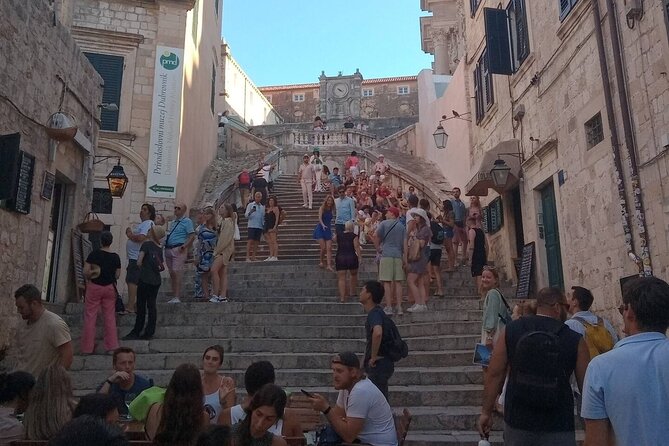
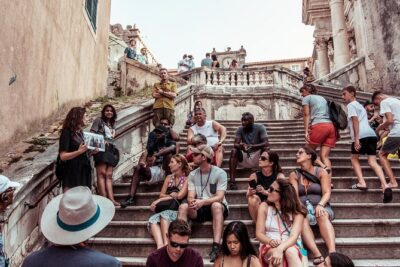
After the civic center, you switch to drama. Church of St. Ignatius of Loyola is paired with the walk over what the guide calls the most famous stairs in Dubrovnik. The key payoff here is the Jesuit Church and its baroque look, described as Dubrovnik’s most beautiful baroque complex.
Even if you don’t feel like a baroque expert, you’ll likely appreciate the visual contrast this stop brings. You also get a reminder that Dubrovnik wasn’t only a Republic trading and governing itself, it was also a stage for major religious orders and architecture.
This stop is short, about 10 minutes, so it’s best as a “wow and move” moment. It gives you a memory anchor without eating up the whole tour.
Stop 6: Rupe Museum viewpoint, an old granary with wall stories
Next is the Rupe Museum area. The standout detail here is that the ethnographic museum is housed in an old granary. That’s the kind of fact that changes how you perceive the space, because it tells you the city used ordinary functional buildings as cultural containers later on.
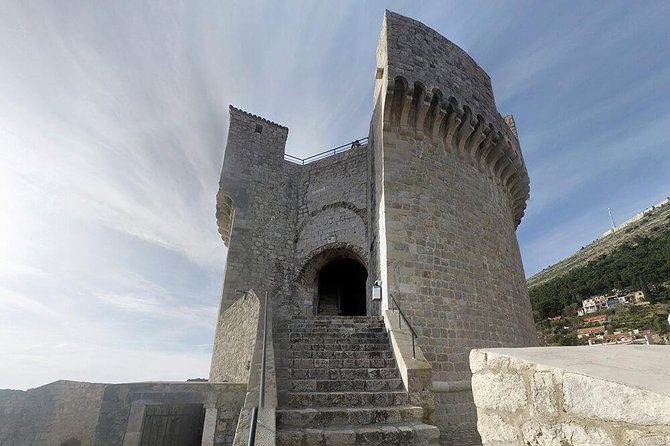
You’ll also get a view of part of the city walls from this area. Even though you are not walking on the walls during this tour, you still get that “I see the wall line” effect in a way that feels earned.
The guide includes a story about the construction of the walls. That’s another reason this stop matters even if you do not plan to pay for museum entry. It ties the city’s defenses to human effort and engineering, which makes the wall look less like scenery and more like a project.
Note again: admission for this kind of stop is not included, so treat it as a viewpoint and storytelling pause rather than a ticketed museum deep cut.
Stop 7: Franciscan Church and Monastery, Onofrio fountain, and an old pharmacy
Your next main cluster is the Franciscan Church and Monastery area, around a small square (Poljana Paska Miličevića). This stop feels like multiple highlights stitched together, which is exactly what you want in a one-and-a-half to two-hour tour.
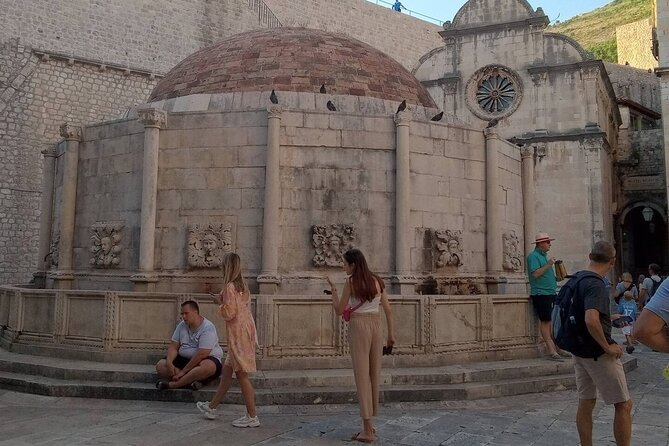
You’ll see and learn about Church of St. Saviour, the Big Onofrio Fountain, and then the Franciscan Monastery with its old pharmacy. That old pharmacy angle can surprise people, because it hints at how the monastery served daily needs beyond religion.
The tour plan lists admission as not included for this stop, so expect more of an exterior and “what to notice” approach than a long indoor visit. Still, the combination of fountain, church, and monastery makes it a strong middle to late-tour section.
Also, this is a great moment to slow down and observe proportions. Dubrovnik’s Old Town can feel visually intense. This pause helps you reset.
Passing the main entrance to Old Town, then finishing at Brsalje Street
After the Franciscan area, you pass the main entrance to Old Town and continue toward the finish line.
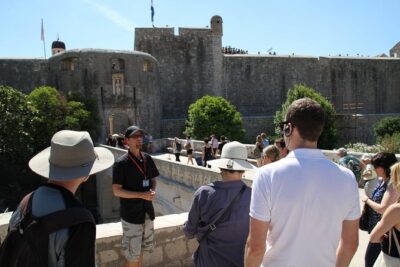
The final stretch is Brsalje Street, connected with Pile Square. This is where you get a last strong viewpoint: the guide points out Lovrjenac Fort and tells you the story of how and why people built the fort.
That ending works because it gives you a clear “last image” to hold onto. When the tour ends, you’re not left with the vague feeling that you just walked a route. You leave with a sense of the city’s defensive logic and the relationship between fort, walls, and town.
The tour also finishes with that story, so the emotional arc lands neatly. It’s a strong close for first-timers.
Price and what you’re really paying for
The price is $47.32 per person, and the tour lasts about 1 hour 30 minutes to 2 hours. On paper, that sounds like a lot for a walking tour. In practice, you’re paying for three things that matter in Dubrovnik.
First, you’re paying for a local guide, Dorotea, who brings stories together into a coherent picture of Dubrovnik as a Republic. If you’ve ever wandered Dubrovnik feeling like you missed context, you know why this matters.
Second, you’re paying for a small group of up to 6 guests. That means better hearing, less time waiting, and fewer people blocking your view at tight spots like stairs and narrow lanes.
Third, you’re paying for efficiency. The tour covers major pillars of the town in a short span: gate entry, harbor function, religion through St. Blaise, government via Rector’s Palace, Jesuit baroque through St. Ignatius, wall context via Rupe Museum, and monastery and fountain stops. You’re not buying museum time or city-wall tickets, so you’re keeping costs focused.
What is not included is also important. Museum entrance tickets are not included, and you will not walk on the city walls. That’s not a downside if your goal is orientation and story-based sightseeing. If your goal is a full day of wall views and indoor exhibits, you’d likely want a different plan or to add separate ticketed stops.
Practical tips so you enjoy it without stress
This tour is short and packed with stops, so small planning choices help.
Wear shoes with solid grip. The Old Town streets can be uneven, and you’ll hit famous stairs around St. Ignatius. Bring water if you’re traveling in warmer months, since you are walking and stopping without indoor time.
Arrive a few minutes early at Ul. Frana Supila 2. In Old Town areas, the timing difference between “right on time” and “slightly late” can be bigger than it should be.
Since some stop entrances are not included, decide in advance what you want. If you are happy with looking and listening, you’re set. If you want to go inside places like Rector’s Palace or museum spaces, plan to add those later so you do not feel rushed during this walk.
Who should book this Old Dubrovnik walk
You’ll probably love this tour if you are:
- doing Dubrovnik for the first time and want to understand what you’re looking at
- short on time but still want more than postcard sightseeing
- interested in the Dubrovnik Republic, politics, religion, and the way the city worked
- the type who appreciates a guide who can explain why things were built and not just what they look like
You might want a different option if you:
- specifically want to walk the city walls as the main event
- want a long, ticketed museum day
- dislike stairs and narrow lanes, since the St. Ignatius stairs area is part of the route
Should you book Charm of Old Dubrovnik?
Yes, if your goal is to get your bearings quickly and come away with real context. This is a well-focused, small-group walk that uses major anchors of Old Town to explain how Dubrovnik thought, governed, worshiped, and defended itself. Dorotea’s storytelling style is the kind that makes the city feel understandable fast, not overwhelming.
If you are hunting for wall-walking time or you want multiple museum interiors included, then this might feel limiting. In that case, pair it with a separate city walls ticket or targeted museum visit later.
For most first-timers, this is a smart buy. You get strong orientation, major sights in one circuit, and an ending viewpoint that ties it together.
FAQ
How long is the Charm of Old Dubrovnik walking tour?
It runs about 1 hour 30 minutes to 2 hours.
What language is the tour offered in?
The tour is offered in English.
What is included in the price?
You get personal guidance by Dorotea, a small-group experience (maximum 6 guests), and a guided walking tour of Dubrovnik Old Town with historical insights.
Are museum tickets included?
No. Entrance to museums is not included, and the tour does not include the ticket for the city walls.
Where does the tour start and end?
It starts at Ul. Frana Supila 2, Dubrovnik, Croatia, and ends at Dubravka 1836 Restaurant & Cafe, Brsalje ul. 1, Dubrovnik.
What is the cancellation policy?
You can cancel for a full refund if you cancel up to 24 hours in advance. If you cancel less than 24 hours before the start time, the amount paid is not refunded.
Newly reviewed in Dubrovnik
- Private Walking Tour through the Old Town of Dubrovnik★ 5.0 · 3 reviews
- Dubrovnik Old City Walls Private Tour★ 5.0 · 12 reviews
- Dubrovnik Private Photoshoot with Local Professional Photographer★ 5.0 · 15 reviews
- Dubrovnik Van Tour for Panoramic Views★ 5.0 · 25 reviews
- Ston Tour: City Walls, Saltworks, Wine & Adriatic Seafood★ 5.0 · 3 reviews
- Private Full Day Peljesac Wine Tasting Tour from Dubrovnik★ 5.0 · 35 reviews
- TOP OFFER: Dubrovnik to Split via Ston, Počitelj, Mostar, Kravica★ 5.0 · 15 reviews
- Pelješac Wine, Beach and Lunch – Relaxing Tour from Dubrovnik★ 5.0 · 15 reviews
Old Town Walking Tours, compared.

City Walls Early Morning or Sunset Walking Tour
Read our review →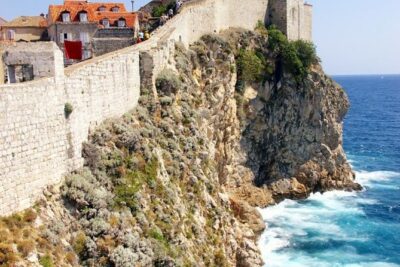
Browse the lists this tour appears in